Willow & Ember

Different businesses.Familiarpatterns.

Every business has its own people, history, habits and way of doing things. But underneath, the moments that make ownership harder than it needs to be are often surprisingly familiar.

You might recognize yours.

The problem underneath

the problem is usually the same shape.

These stories aren't about any one business. They're patterns that show up again and again inside owner-led companies, told the way they tend to unfold. Each one moves from what you might be noticing, to what may be causing it, to what the work of strengthening it could actually look like.

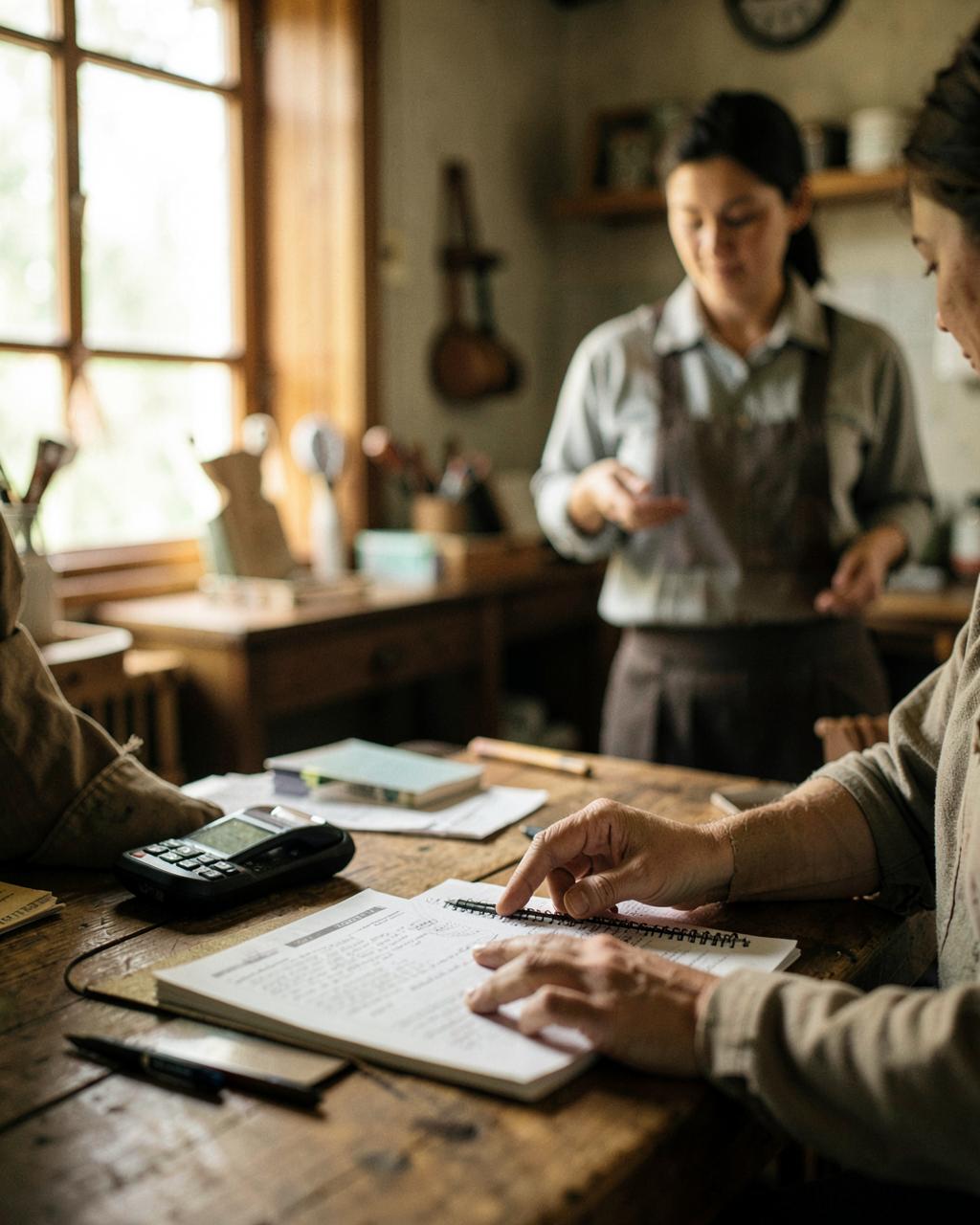
Hands pointing to an open notebook at a busy shop counter while a staff member waits with a question
01

The owner everyone needs

The day is full of small questions. Can we do this for a customer? What should I say to this supplier? Is this the right price? None of them are hard on their own, and the team is capable. But the questions keep finding the same desk, and by five o'clock the owner's own work is still waiting.

Underneath, the issue is rarely the questions themselves. It's that the judgment behind the answers still lives with one person. The team may know how to do the work, but not where they have room to decide, what rules apply, or what happens when something falls outside the usual.

We would start by listing the questions that return most often, then trace each one to the decision behind it. Some may become simple documented guidelines the team can apply. Others may need clearer ownership, so it's obvious who decides. The work might begin with a single page of answers, built in the team's own language, tested in real situations as we go.

When the judgment is on paper and the ownership is clear, the questions do not disappear. They just stop needing the owner. And the hours that come back tend to go to the work only the owner can do.


02

The business that outgrew its memory

Ask how something gets done and the answer is a name. Ask how month-end works, or how a new customer gets set up, or what happens when an order goes wrong, and the reply is some version of: talk to the person who has always done it. The business runs on knowledge that has never left anyone's head.

This is what growth looks like from the inside. The way of doing things that worked for three people stops working at eight, but nothing replaces it. Every process stays informal a little too long, until key knowledge and key people become the same thing.

The work would begin by mapping how things actually happen today, not how anyone thinks they happen. We would sit with the people doing the work, capture the real steps, and write them down in plain language. Then the fragile parts get strengthened: the handoffs, the exceptions, the steps only one person knows.

A business with its knowledge on paper is a sturdier place to work. Holidays stop being a risk. Training gets faster. And the owner is no longer the only copy of how the company works.

Two people's hands over a worn notebook of handwritten processes, loose notes and laptops on a wooden table
A small team around a wooden table looking at a hand-drawn workflow in an open notebook
03

The team that keeps asking

The people are good. They were hired carefully and they care about the work. Yet decisions still travel upward for approval, even small ones. Staff check before acting, wait for sign-off, and bring back choices they could reasonably have made themselves.

Usually this is not a confidence problem. It is a clarity problem. When responsibilities are described loosely and decision-making authority is never spelled out, asking first is the rational thing to do. The team is not hesitating. It is reading the business accurately.

We would look at who actually owns each area of the business, and where that ownership is assumed rather than stated. The work might involve rewriting how roles are defined, agreeing which decisions sit where, and giving the team explicit room to act. Then we would test it in practice, one real decision at a time.

When people know what is theirs to decide, they decide. The owner stops being a checkpoint and starts being a leader again, and the team gets to be as capable as it always was.

04

The software nobody really uses

There is a tool for scheduling, a tool for invoicing, a tool someone set up two years ago that half the team forgot existed. And yet the real work still runs on spreadsheets, sticky notes and memory. Every new system was going to fix things. None of them quite did.

Software rarely fails on its features. It fails because it was added on top of an unclear process. When nobody has agreed how the work should flow, each tool becomes one more place to look, and the workarounds quietly become the real system.

We would start with the work itself, not the tools. Which steps actually need to happen, in what order, owned by whom. Only then would we look at the stack: what genuinely supports that flow, what duplicates it, and what can be retired. Sometimes the answer is better setup. Often it is fewer tools.

When the process leads and the software follows, the tools finally earn their place. The team trusts the system because it matches how they actually work, and the sticky notes can go back to being reminders instead of infrastructure.

A laptop on a back-office desk covered in sticky notes, printed spreadsheets and a half-finished checklist

These stories reflect familiar patterns across owner-led businesses, not accounts of any one company. If one of them felt familiar, that recognition is exactly where a first conversation begins.

An open invitation

Let's talk.

An hour on a call. No pitch, no proposal deck. You leave with a clearer read on your business, whether we work together or not.